中文
President Sean Stein,
Ambassador David Perdue,
Ladies and gentlemen,
Dear friends,
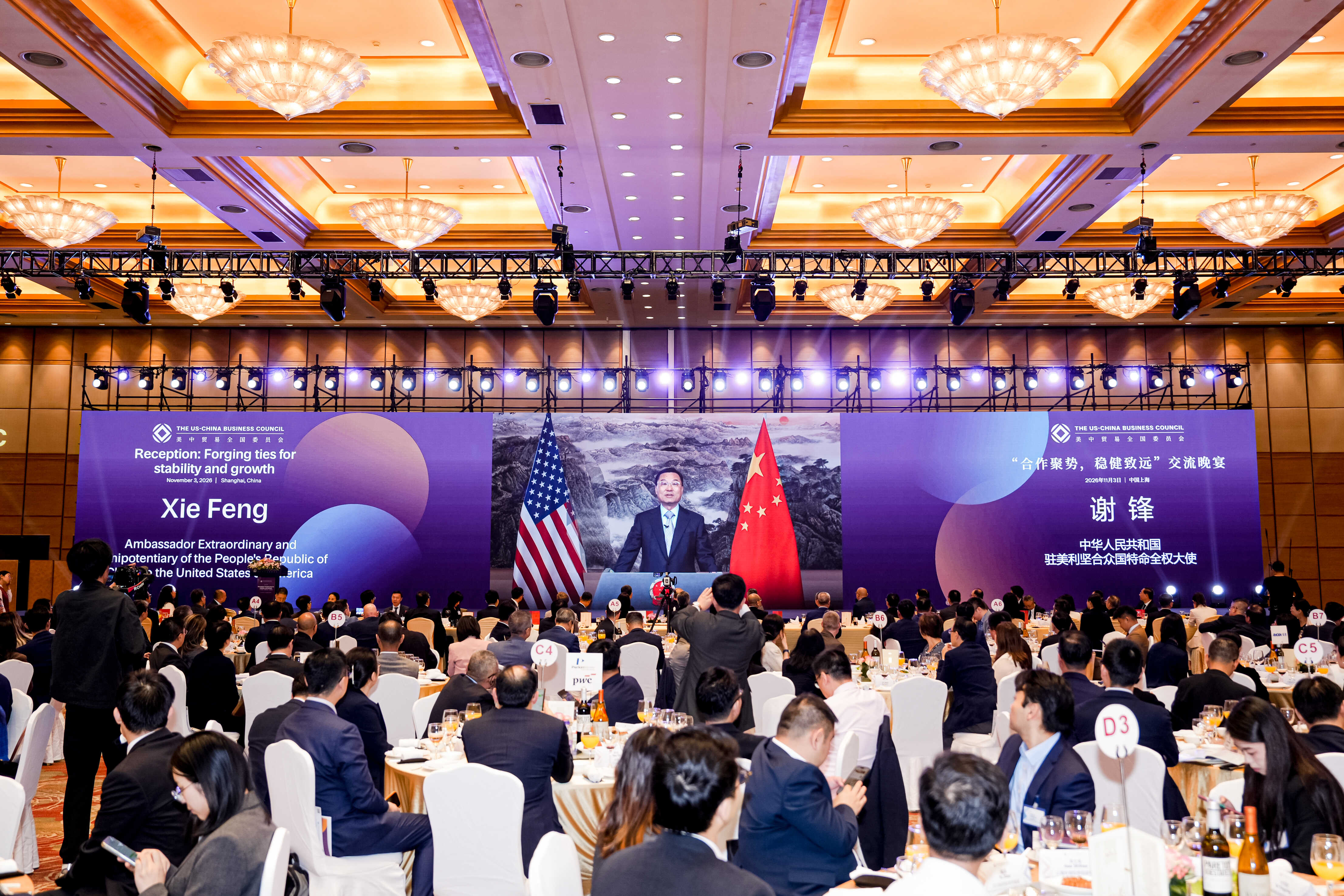
Good evening! It gives me great pleasure to once again join friends old and new from the business community virtually in Shanghai.
This year is a big year for China-U.S. relations. With the Beijing summit in May and the Washington summit in September, the two heads of state have exchanged state visits within less than half a year. The Beijing summit established a new vision of building a constructive China-U.S. relationship of strategic stability, and the Washington summit further enriched its substance by incorporating the principles of respect, fairness, and reciprocity. This has both recalibrated the course for the giant ship of China-U.S. relations, and set the direction for bilateral economic and trade cooperation.
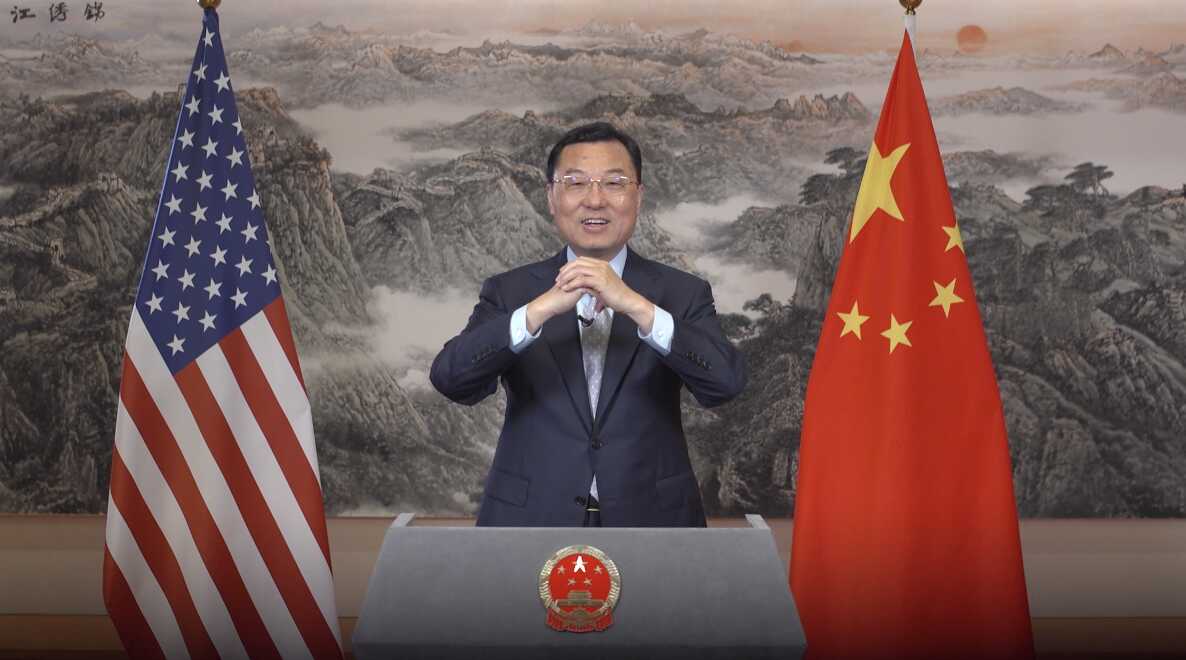
First, it is important to uphold mutual respect, so as to enhance mutual trust and strengthen the foundation for China-U.S. economic and trade cooperation.
While China and the United States have different histories, cultures, social systems, and development paths, that gives us even more reason to respect each other, view our differences rationally, and handle them in a pragmatic manner. Since the start of last year, our two economic and trade teams have held eight rounds of consultations, and “mutual respect” has been incorporated into the deliverables many times. The latest round of consultations in September reached ten deliverables, including establishing and advancing mechanisms such as the Board of Trade, agreeing to reduce tariffs on about US$30 billion worth of goods imported from each other on a reciprocal basis, and extending the Kuala Lumpur economic and trade arrangement.
All these deliverables could not have been achieved without equal-footed consultations based on mutual respect. They have addressed both sides’ market demands and industrial concerns, while also creating a more stable and predictable environment for business operations. Facts have proven that, only when we build up mutual understanding, trust, and consensus through mutual respect, can we keep expanding the list of cooperation while shortening the list of problems, and open up broader space for bilateral economic cooperation.
Second, it is important to champion fair competition, so as to inject fresh vitality into China-U.S. economic and trade cooperation.
While it is a fact that there is competition between China and the United States, such competition should be fair, rule-based, and with clear boundaries. As the saying goes, “Some days you win, some days you lose.” We should not decide the result in advance, and calling foul /faʊl/ once we lose.
As the new round of scientific and technological revolution is gathering pace, competition in emerging areas is becoming especially intense. In the field of artificial intelligence, for example, the United States has strengths in basic research, advanced chips, and frontier models, while China has a wide range of application scenarios, a fully-fledged industrial system, and a vast market. The two sides need to compete to innovate, advance applications, and deliver more benefits to humanity, rather than arbitrarily accusing the other of “distillation”, drawing a “silicon curtain”, engaging in zero-sum game, or even waging an AI war. The same is also true for other fields, such as biomedicine and advanced manufacturing.
Third, it is important to deepen mutually beneficial cooperation on the basis of reciprocity, so as to broaden the scope for win-win China-U.S. economic and trade cooperation.
China is probably the only high-potential market in the world that boasts both massive scale and vibrant novelty. Our doors are opening up wider and wider. We have removed all market access restrictions for foreign investors in the manufacturing sector, and have been further opening up service industries, such as telecommunications and healthcare. We have remained the world’s second-largest importer for 17 consecutive years, with total imports surpassing $2.6 trillion in 2025 and growing by 22.3% in the first three quarters of this year.
In just two days, the ninth China International Import Expo will open in Shanghai. A total of 162 countries, regions, and international organizations will take part, with 4,142 overseas companies exhibiting. The total exhibition area will exceed 440,000 square meters for the first time, with U.S. companies taking up the largest space for eight years in a row. According to a USCBC report this year, 92% of U.S. companies surveyed report profitability in China last year, and 95% of respondents see China operations as important for staying competitive globally. All these have demonstrated that, the vision of China and the United States helping each other succeed and prospering together is a tangible prospect within reach.
Reciprocity is fundamentally a two-way street. The U.S. side is still tightening restrictions on investment in China, and politicizing and imposing security implications on economic and trade issues. This is not the right way to move in the same direction, and we count on our friends from the business community to encourage the U.S. government to change course.
Ladies and gentlemen,
Dear friends,
Last week, the 20th Central Committee of the Communist Party of China successfully held its fifth plenary session, sending a positive signal to the world that China will keep its policy consistent and stable, and stay committed to high-quality development and high-standard opening-up. Friends from the U.S. business community are always “early birds” with both vision and action. It is my hope that you will seize the new opportunities China offers, and further tap into the vast potential of its market. For businesses around the world, China is not only a premier “fitness club” and a vibrant “arena”, but also a “winner’s podium”. I encourage you to sharpen your competitive edge in this “fitness club”, inspire one another to achieve excellence in this dynamic arena, and ultimately share the podium through win-win cooperation.
Thank you very much.