中文
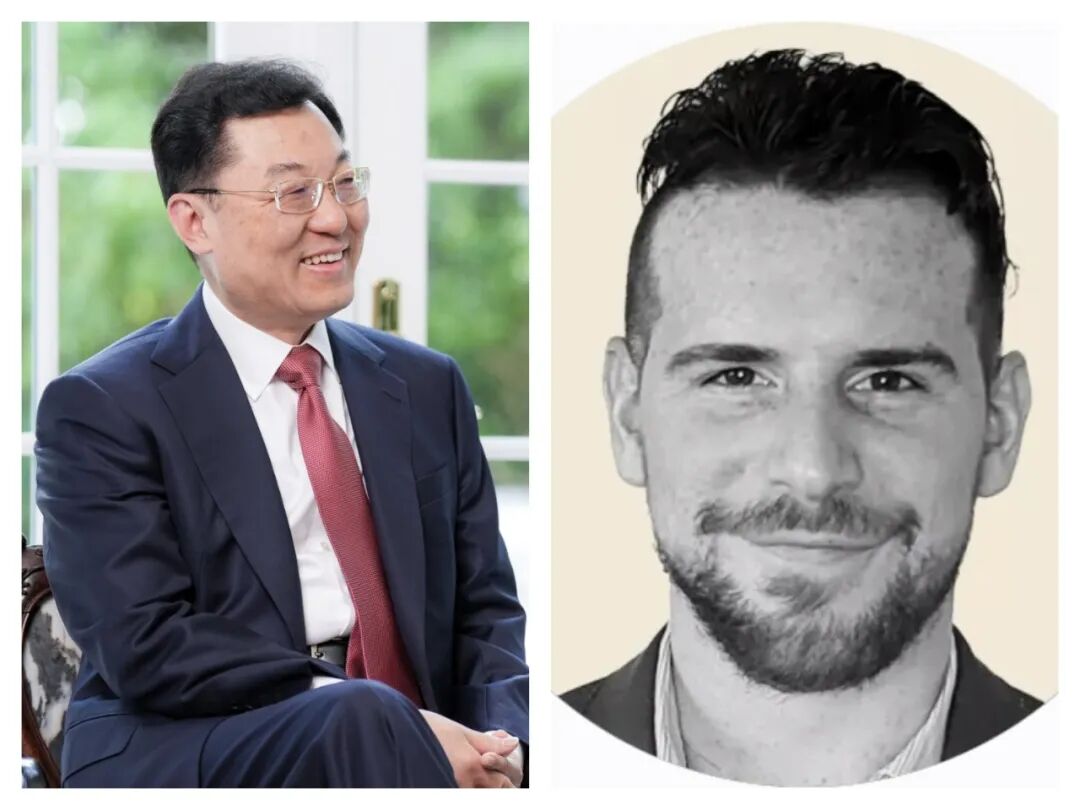
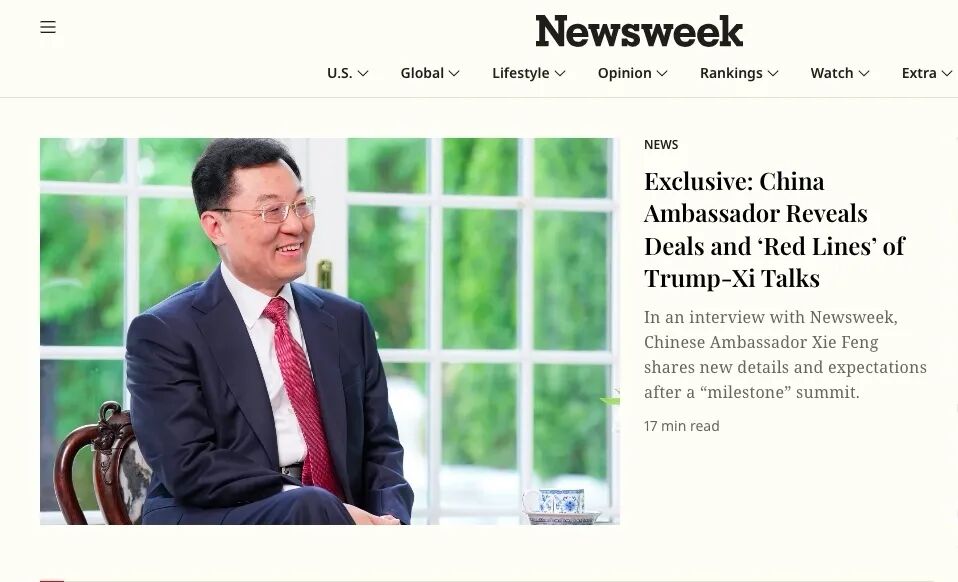
On September 29, 2026, Chinese Ambassador to the United States Xie Feng gave an exclusive interview to Senior Foreign Policy Writer Tom O’Connor from Newsweek on President Xi Jinping’s state visit to the United States and China-U.S. relations. The full transcript was published on the Newsweek website on October 1.
Tom O’Connor asked: One major topic the two Presidents discussed at the summit was artificial intelligence (AI), and the two sides have agreed to establish channels of communication to mitigate its risks. But shortly after the visit, the U.S. government stressed again the pursuit of AI dominance over China. Is this in some ways the next form of “arms race” or “space race” among superpowers, and will it exacerbate the existential threats that emerging technologies such as AI pose to humanity?
Ambassador Xie said that China always maintains that technology should be people-centered and developed for the positive and for good, so as to serve the progress of humanity. As leading nations in AI, China and the U.S. share a special responsibility. We need to jointly install guardrails and brakes, rather than engaging in an arms race or drawing down the iron curtain. During this visit, President Xi Jinping pointed out that China and the U.S. have both the capability and responsibility to develop and manage AI for good, and to ensure that the development of AI is always under human control and serves the well-being of the people. We may have competition, but we may cooperate even more. The right thing to do is to draw on each other’s strengths, not guard against each other. The two sides held the first AI Dialogue in September, and will hold the next round in November, to exchange views on risks and benefits related to AI and jointly prevent the misuse and abuse of AI. The two sides have also agreed to establish a bilateral communication channel for AI incidents. This proves that AI can very well become a new frontier for China-U.S. cooperation, rather than a new arena for confrontation or conflict.
In recent years, Chinese large AI models such as Deepseek, Seedance and Kimi have evolved rapidly and gained popularity among developers worldwide, including in the U.S. Global downloads of the models have exceeded 10 billion. When an AI model escaped the sandbox in the U.S. in July, it was an open-weight model developed by a Chinese company that came to the rescue. Facts have proven that open source and openness do not create insecurity; rather, technological decoupling, enclosure, and self-isolation are the real recipe for risk. We hope the U.S. side will work with China in the same direction, help each other succeed with an open mind, and live up to our shared responsibility through cooperation, so as to jointly ensure that rather than heralding the dusk of humanity, new technologies such as AI will usher in the dawn of a new era.