中文

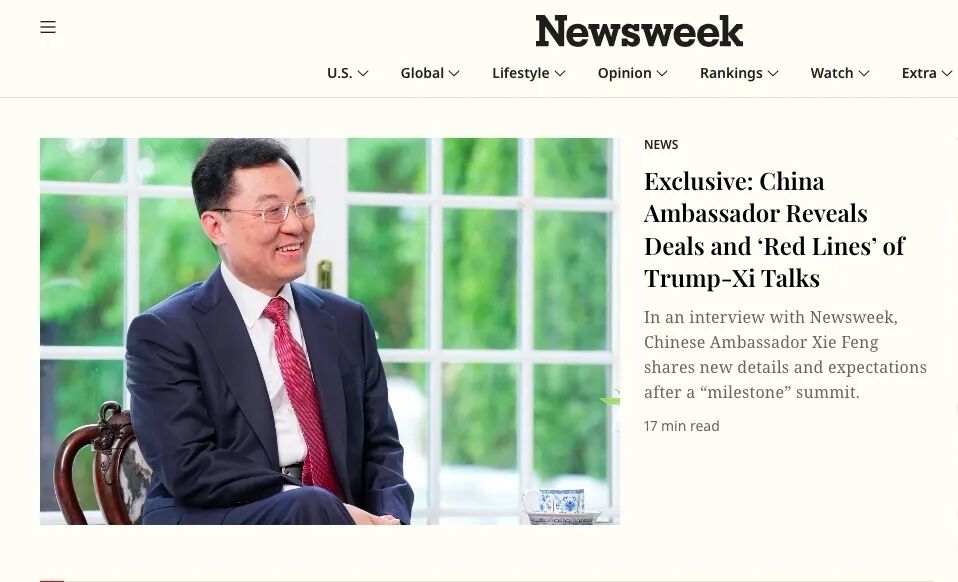
On September 29, 2026, Chinese Ambassador to the United States Xie Feng gave an exclusive interview to Senior Foreign Policy Writer Tom O’Connor from Newsweek on President Xi Jinping’s state visit to the United States and China-U.S. relations. The full transcript was published on the Newsweek website on October 1.
Tom O’Connor asked: The two sides agreed to extend trade truce by two months, which is shorter than the one-year extension expected by some. What progress was made at the latest round of economic and trade talks, and does China retain options to counter further challenges from the U.S.?
Ambassador Xie said that from September 20 to 23, the economic and trade teams of China and the U.S. held the eighth round of economic and trade consultations in New York and Washington, D.C., reaching ten deliverables of practical cooperation. Namely, the two sides agreed to establish the Board of Trade and the Board of Investment; agreed to reduce tariffs on about US$30 billion worth of goods imported from each other on a reciprocal basis; agreed to establish an agricultural working group to expand practical cooperation in agriculture; reached a consensus in principle on financial services; established a dialogue on artificial intelligence; extended tariff suspension through Jan. 10, 2027, and agreed to continue actively discussing the issue; exchanged views on increasing direct passenger flights; and renewed their commitment to fully implementing the consensus reached in previous rounds of economic and trade talks; China will also import U.S. coal. All these outcomes will help stabilize bilateral economic ties, expand trade, and strengthen our cooperation in agricultural products, energy, manufactured goods, and consumer goods. They will also contribute to the stable growth of the global economy.
It needs to be emphasized that the economic and trade relationship between China and the U.S. is mutually beneficial in essence, and strengthening cooperation is both an inherent need of both sides and the right choice. Cooperation should be a two-way street. China is willing to be a partner and friend of the U.S. We hope the U.S. side will actively respond and take action to work with China in the same direction to lengthen the list of cooperation and shorten the list of issues. We should not refrain from doing a good deed because it is too small, nor commit a bad deed because it is too small. In this way, we can not only bring tangible benefits to both our peoples, but also instill stability and positive energy into the world economy.