中文

Director Chase Robinson,
Director Aviva Rosenthal,
Deputy Director-General Zhu Ye,
Distinguished Guests,
Friends,
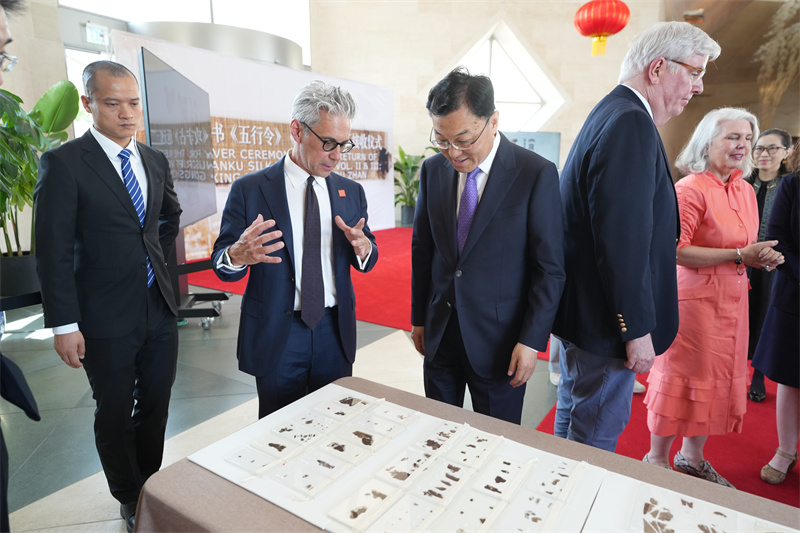
I’m so delighted to witness the return of the Zidanku silk manuscript Vol. II and III: Wuxing Ling and Gongshou Zhan to their homeland. Protecting cultural relics benefits both the present and future generations.
I express my sincere thanks to the National Museum of Asian Art and the Smithsonian Institution, and deep respect to all Chinese and American professionals devoted to heritage preservation.
Each artifact is a non-renewable embodiment of civilization and a shared treasure of humanity. The Zidanku silk manuscript—over 2,000 years old —are the earliest known silk texts and the only ones from China’s Warring States period. With over nine hundred characters and rich in myth and numerology, the manuscript reflects the depth and endurance of Chinese civilization, having great significance to studying ancient Chinese characters, literature and thinking. Their return is a cultural milestone and a testament to China-U.S. cooperation in heritage preservation, bringing new vitality to people-to-people exchange and friendship.
Each artifact carries the spirit and lineage of a nation, touching the hearts of all Chinese people. As President Xi Jinping has pointed out, "cultural relics reflect the splendor of civilization, preserve the legacy of history, and uphold the spirit of the nation." Lost to foreign lands in times of national weakness, Chinese cultural relics are returning home with the rejuvenation of the Chinese nation. Since 2012, over 2,000 relics have returned—testifying to our commitment to heritage protection and the respect of other countries for China’s cultural sentiment.China and the U.S. have made notable progress in heritage cooperation, with around 600 artifacts sent back to China—including more than 40 pieces since the start of this year. These returns are vivid examples of friendship and international collaboration to reclaim and protect humanity’s shared legacy.
Each artifact is a key to cultural connectivity—unlocking dialogue across time, borders, and civilizations. Museums give voice to cultural relics, revealing ancient wisdom and the richness of diverse cultures. From the Empresses of China’s Forbidden City exhibition in Washington to Treasures of Jiangnan in Cleveland, joint exhibitions have opened windows for Americans to engage with Chinese culture.Frequent exchanges—such as the Pritzker Museum Leadership Forum in Chicago and the AAM Annual Meeting in Los Angeles—have built bridges for deeper collaboration between Chinese and American museum communities.
In China, museums are getting more popular. During the recent May Day holiday, many museums saw record visitors and sold-out tickets. As the world’s largest middle-income population seeks richer cultural experiences, China’s growing demand will create new opportunities for China-U.S. cultural exchange and cooperation.
Friends,
Cultural relics, though silent, speak volumes. The successful return of the Zidanku silk manuscript reminds us that, through dialogue and cooperation based on equality, mutual respect and mutual benefit, the two countries can deliver important and tangible results good for both sides and beyond. The China-U.S. relationship should not be a zero-sum game. The key is to find solutions that serve both sides, and pursue the right path to get along in the new era. This is what the two peoples and the world want to see. It is also a due responsibility for us as two major countries. We call for more voices of reason and more efforts that benefit both sides. We hope the U.S. side will work with China in a spirit of mutual respect, peaceful coexistence and win-win cooperation, for an early return of the bilateral relationship to sound, stable and sustainable development. That will bring more certainty and stability to this fast-changing world.
Thank you.